TRANSLATION -- select your language below:

August 21, 2015

"Slime mold" is for real

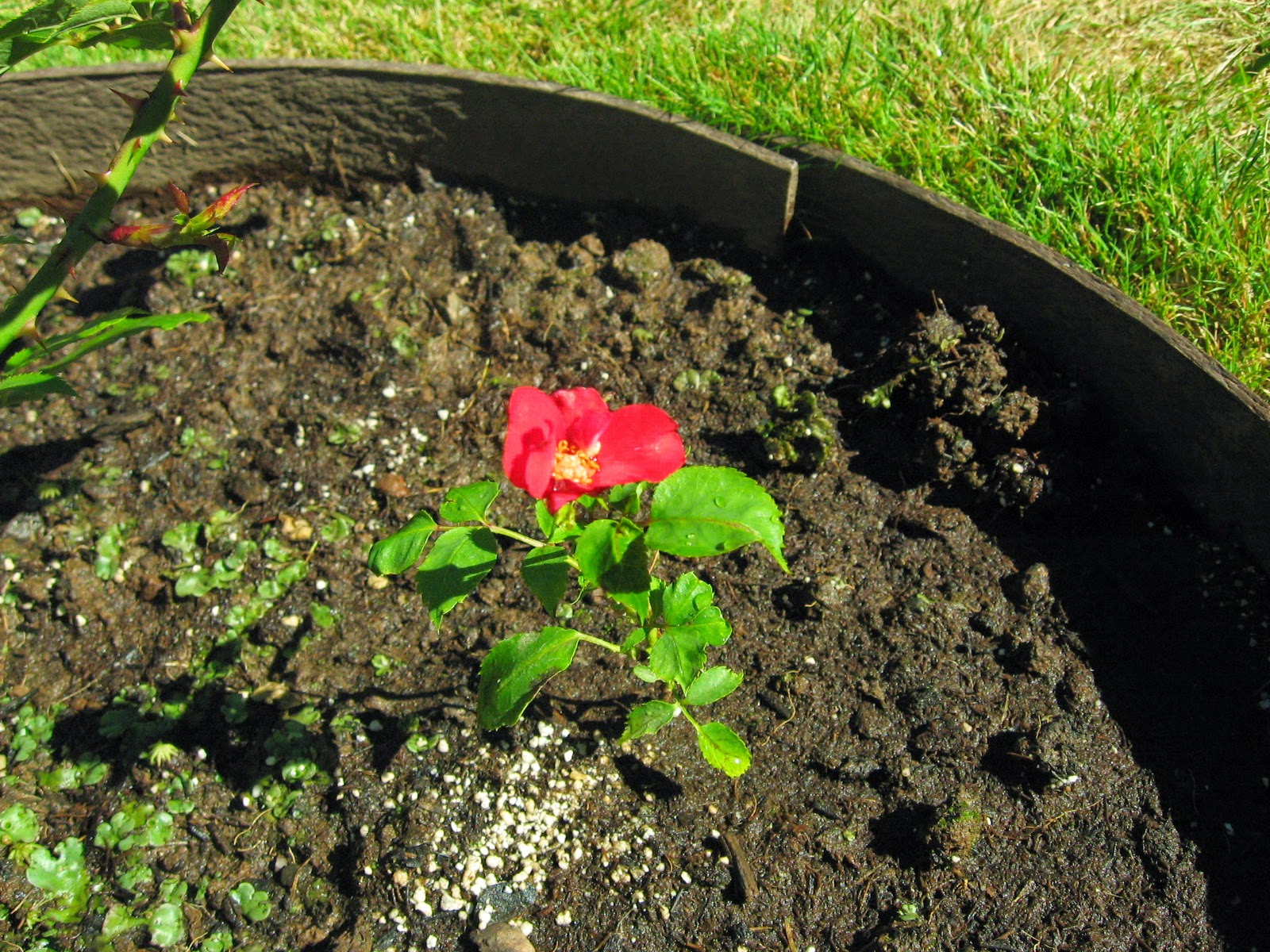
If you have never heard of slime mold, or don't believe that it exists, then I have news for you.  I've seen it with my own eyes, and it's in my backyard rose bed right now.  The combination of moss and liverworts covering the rose bed is gradually maturing and slowly producing decayed material that is proving to be a good host for the mold.  According to Wikipedia, there are more than 900 species of slime mold, and a search through Google Images shows that it comes in several different colors.  Mine happens to be bright white, and the larger of the two lumps shown in the photos below measures around 1" by ¾".  As you can see, it's just a few inches away from one of my roses, so I'll have to keep an eye on it.


August 19, 2015

The TIME MACHINE

As I was watering the roses this morning, one particular bloom really caught my eye.  It was a white bloom on one of my 'Queen Elizabeth' seedlings, and it got me thinking about firing up my virtual time machine consisting of two pieces:  home computer and digital camera.  We can look back to June 14th of 2009 when I took a photo of this rose's first bloom, when the plant was just 2½ months old.  Then we'll zoom forward 6+ years to today to see what it was that caught my eye --

Photo taken:  June 14, 2009
Photo taken:  August 19, 2015

August 16, 2015

They have it MADE IN THE SHADE

Sometimes an experiment can be successful, so it pays to be adventurous out in the rose garden.  I knew that the small empty patch of ground that faces north in my backyard would provide good shade for starting several cuttings from my 'Red Galaxy' rose.  The cuttings were taken in the first half of June (2014), individually potted, and then placed atop the aforementioned patch where they received at most 2 hours of direct sun each day.  To seal the deal, they all were misted several times a day  -- you do what  you have to do when you don't have a greenhouse.  The photo below to the left shows the cuttings after about 1 month.  They were doing so well that I decided to let them permanently reside in the shady patch.  I'll refer you to my post of September 22, 2014 titled "The chicken inspector" to see how they looked after being planted out.  The photo below to the right shows them today, healthy plants with bright blooms in an otherwise shady spot.

For this experiment, two factors were in my favor.  First, the shade is house shade, not tree shade, so bothersome tree roots won't be spoilers.  Second, the chosen rose variety mostly has blooms of 5 petals, so the blooms open a lot easier than a heavier petalled rose.

Photo taken:  July 17,  2014
Photo taken:  August 16,  2015

July 10, 2015

High noon in the back yard

The back yard constantly beckons to have photos taken, even at high noon.  Whether in full sun, or with overcast, the two photos below were taken around noon time.  But to tell the truth, the photos are both actually composites created using photo stitching software on my computer.  They are best viewed if you click on them for enlargement.  The photo to the left is from my favorite viewing spot, close to the rose bed, and getting the full effect of the giant rose bushes in the background.  Two of the bushes, grown from seed, are now 8 feet tall, and a few more seedling roses rise to 7 feet.  The "photo" is really a composite of 4 photos, and is set up using the "matrix" feature of the software.  The result gives a pretty fair representation of what I actually see in person.  The stitched photo to the right speaks for itself, but in a language understood only by my avian friends.

The MATRIX
Photo taken:  July 10, 2015
The FLOCK
Photo taken:  June 24, 2015


June 27, 2015

Roses in the morning

My best rose photos, especially during the hot Summer months, are taken in the morning.  Blooms are beginning to open, but the day's heat hasn't sapped them of their youth.  Below are some striking examples of bloom clusters from four of my rose seedlings, obtained from open pollination of their parent rose: 'Queen Elizabeth'.  The progeny of this parent rose are likely to bear roses in clusters, as 'Queen Elizabeth', the first of the Grandiflora class, is heavily indebted to the Floribunda roses.  For additional photos of select bloom clusters, see my post of July 5, 2014 titled "Royal roses".

Photo taken:  June 27,  2015
Photo taken:  June 26,  2015

Photo taken:  June 9,  2015
Photo taken:  June 12,  2015

Update of September 4,  2015:   The pretty roses just keep coming.  Below are blooms from four more of my unnamed seedlings from the 'Queen Elizabeth' rose.  Considering that their open pollination beginnings were very likely the result of SELF pollination, the implication is that there must be much diversity in the gene pool of the 'Queen Elizabeth' rose, which is quite true (and you don't have to go very far back in its ancestry).  These eight rose photos (4 above + 4 below) are testimony to that diversity.

Photo taken:  June 28,  2015
Photo taken:  July 3,  2015

Photo taken:  July 5,  2015
Photo taken:  September 3,  2015

June 16, 2015

Visitors !

The garden is in mid-season form now, and some guests from the Salem Rose Society paid a visit yesterday evening.  Through the magic of digital photography and the Internet, you can share their experience via the following photos.  The first photo shows the welcoming display of rose blooms along the driveway, and the second photo shows the back yard and the esteemed visitors.  If you feel like "surfing the web", here is a link to the web site (blog) of the Salem Rose Society:  Click here to transfer to the SRS blog    (But don't forget to come back here !)

Photo taken:  June 15, 2015

Photo taken:  June 15, 2015

Update of August 31, 2015:    Please allow me to introduce you to the "ground cover" that you see amongst the driveway roses in the upper photo.  It's not as exotic as the liverworts and mosses in the back yard rose bed, but I like it just the same.  The name of the humble yet indomitable cover is Sagina procumbens.  In the driveway bed I treat it with respect, and it gives a bit of a wild aura to the rose display.  Examining the lower photo, there's some Sagina in the back yard also.  There it is in the circular wells surrounding the 'Queen Elizabeth' roses interspersed in the lawn.

May 14, 2015

Another sign of global warming ?

Back in 2012, I documented some benchmark events, such as when the first rose bloom opened; I refer you to my post of May 14, 2012 ("First open bloom of the year !").  Well, here we are exactly three years later and there is quite a difference in the timing of bloom production.  We've had some spells of warmer than normal weather from January through May, and I can't help but think that global warming may be playing a big role.  Dozens of my rose bushes have already opened their first blooms, and the rose garden is full of color today, May 14th.

Photo taken:  May14,  2015
Photo taken:  May 14,  2015

April 30, 2015

Ushering in the new rose year

It's been almost 5 months since my last posting, and I can hardly contain my excitement that the new ROSE YEAR has begun.  The first open bloom this year (and the earliest in my 8 years in Salem) was on April 21, and you'll see it in the 3rd photo below.  But first let me show you one of my 'Queen Elizabeth' seedlings; the photos are of the same rose bloom taken 2 days apart.  With just 20 petals, this rose will always find it easier to open, so in a way it is suited to the cooler climate here in Oregon.  The bloom in the photo on the left is a generous 5 inches across.  By the way, a 4 bloom cluster of this rose can be seen in my posting of July 5th, 2014 ("Royal roses").

Photo taken:  April 30,  2015
Photo taken:  April 28,  2015
The photo below on the left is another of my 'Queen Elizabeth' seedlings, and it bears the distinction of being the earliest bloom this year.  As expected, the petal count is low, but the bloom is really colorful.  The rose to the right is one of my 'Red Galaxy' clones that I grew from a cutting last year.  The bloom fully opened today and the plant is the 2nd rose from the "chicken" that can be seen in my posting of September 22nd, 2014 ("The chicken inspector").  My experiment of growing nine 'Red Galaxy' clones along the north side of the house appears to be successful, as all nine plants are already showing multiple flower buds.

Photo taken:  April 21,  2015
Photo taken:   April 30,  2015

December 5, 2014

Early dormancy

This past  November was unusually windy, wet, and cold.  The rose bushes were smart enough to call it a year and save their energy for next year by just going dormant.  Here they are in a "stitched" photo that I took two days ago, during a brief respite from the rainy weather:

The rose garden
Photo taken:  December 3, 2014

Mostly GREEN up there, so maybe I should add a bit of color to this post by including photos of two of my unnamed seedling roses which produced some very pretty blooms last summer.  Notice how the petals darken as they age on the blooms of the 'Voodoo' seedling.  The rose bushes below resulted from open pollination of their respective parent roses.

Seedling of the 'Voodoo' rose
Photo taken:  August 31, 2014
Seedling of the 'Queen Elizabeth' rose
Photo taken:  July 26, 2014

This is a very auspicious day to be "blogging", as this marks the Third Anniversary of this blog, which I began on December 5th of 2011.  There's a lot of rose ruminating going on here, and I do hope that you enjoy reading this blog.  For those of you who would like to read the blog in a language other than English, just click on the TRANSLATION drop-down menu at the top of the blog and then select your preferred language.

September 22, 2014

The chicken inspector

No, the title of this post does not refer to an employee of the US Department of Agriculture.  Rather, as seen in the photo to the left below, it refers to my backyard chicken who is inspecting a row of clones from my 'Red Galaxy' rose bush.  Speaking of clones, I've come a long way from the single clone that I talked about in my post of August 26, 2012 which was titled The clones are coming !   It would now be accurate to say that they have arrived !  The clones shown below were grown from cuttings that I took in early June, so they are doing quite well in just 3½ months.   The mother of the clones, 'Red Galaxy', was also looking good today considering that Fall begins in just a few hours -- 7:29 pm (PST) tonight.  Its photo is on the right.


The chicken inspector
'Red Galaxy'

September 13, 2014

Rose reorganization

The time finally arrived when I had to space out some of my 'Queen Elizabeth' rose seedlings because they were just getting too big.  Then again, some of my 'Voodoo' seedlings were underperforming and were too small.  So it was time to shuffle the roses, thirty-eight of them to be exact.  Some 'Voodoo' seedlings were moved from the big backyard rose bed to the driveway strip, some other 'Voodoo' seedlings were moved from the driveway strip (and backyard bed) to a new bed -- the REHAB bed.  Then, quite a few 'QE' seedlings were transplanted to the vacated places in the backyard bed.  Some of the 'Red Galaxy' clones that I've been starting from cuttings were also moved to the vacated spaces.  This left my remaining 5 seedlings from 'Red Galaxy' to be re-arranged in their own seedling bed (they are still very small).  And for good measure, some of the smaller 'QE' seedlings were moved to the forefront of the backyard bed (might as well call it the "rehab row") so that they would get more exposure to the sun.

Enough talking;  it's time for some photos of the results:

The driveway strip
Photo taken:  September 13, 2014

The backyard bed
Photo taken:  September 13, 2014

The 'Red Galaxy' seedling bed
Photo taken:  September 13, 2014
The REHAB bed
Photo taken:  September 13, 2014

Update of September 1, 2015:   Two of the seedling roses in the "rehab row" were looking very pretty today.  Even though the plants have similar looking blooms, their ancestries are quite different.  The rose to the left below is an open pollinated seedling of 'Queen Elizabeth', whereas the rose in the photo to the right is one of the two siblings of my 'Red Galaxy' rose.  Those three siblings share the same ancestry, namely an unlabeled rose growing in Germany.  Both of the rose plants shown below are over 5 years old, and their diminutive size has earned them spots in the "rehab row".

Photo taken:  September 1,  2015

August 10, 2014

Seedlings of 'Red Galaxy'

To gain a better understanding of this post, please review my earlier post of April 16, 2014 (My latest "SCIENCE PROJECT"), and also the material that you will read by clicking on the TAB labelled German Seedlings.

Four of my six seedlings from 'Red Galaxy' have produced their first blooms already, but two have yet to develop flower buds (hopefully they will soon catch up).  Below you will see photos of the first four seedlings with their first blooms; I have identified the seedlings by their birthdays.

Birthday:  March 19, 2014
Photo taken:  July 29, 2014
Birthday:  March 26, 2014
Photo taken:  July 30, 2014

Birthday:  March 27, 2014
Photo taken:  July 25,  2014
Birthday:  April 4, 2014
Photo taken:  August 10, 2014

With my "trained eye", I am seeing in these blooms some of the attributes of 'Red Galaxy' and even what I think are ancestors of 'Red Galaxy'.   As the bloom shown in the 3rd photo aged,  the "volatility" inherent in the ancestry of 'Red Galaxy' becomes apparent, as you can see in the photos below.

Birthday:  March 27, 2014
Photo taken:  July 27, 2014
Birthday:  March 27, 2014
Photo taken:  July 30, 2014

July 19, 2014

The VERTICAL dimension

Quite a few of my seedlings resulting from open pollination of the 'Queen Elizabeth' rose have inherited her tendency to grow rather tall.  For example, my seedling that was born (the sprout surfaced above the soil) on March 19, 2009 is now 5 years and 4 months old, and it stands a full 8 feet tall.  Today  I stacked and stitched together 2 photos in order to get the entire rose in one frame, as shown below.

Photo taken:  July 19, 2014

Below on the left is a cluster of semi-double blooms that were half way up the rose bush, but are somewhat hidden in the full-length photo above.  And below to the right is a photo of this rose's very first bloom, which fully opened on June 1, 2009.

Photo taken:  July 19, 2014
Photo taken:  June 1, 2009


July 5, 2014

Royal roses

Small clusters of blooms have the potential for some of the best rose photos.  You have to be vigilant out there in your garden, and sometimes you will find some real gems.  The roses shown below all have one important thing in common:  they are all unnamed seedlings resulting from open pollination of the great 'Queen Elizabeth' rose.  Royalty indeed.


June 24, 2014

Summer photos

It's time to try my luck again with some "panorama" (stitched) photos of the back yard rose bed.  We'll get a couple of perspectives from the photos below; just click on the photos to enlarge them.

Photo taken:  June 22, 2014
Photo taken:  June 24, 2014