It was 4 days ago, November 15, when we had the last sunny day around here, and who knows when we might see a sunny day again. I took advantage of the light to photograph a bloom on one of my German seedlings. As luck would have it, all the higher-up blooms around the rose bed were out of range, so the photo captures just the one open bloom. It's also the one in the tiny vase on the kitchen counter. Here's the photo of November 15:
TRANSLATION -- select your language below:
November 19, 2012
Wet and windy (as expected)
There was no way that we could have escaped November without some severe rain and wind. I just emptied out my rain gauge, which had an inch and a quarter of rain accumulated in just the last three hours. By the way, the background scenery for this blog is VERY appropriate for the Pacific Northwest, don't you think?
I did have enough time this morning to get out in the rose bed and prune some of the longer canes that were being thrashed about by the wind. In the process, I salvaged a small vase-full of late blooms to bring indoors. Below are a couple of photos that I took today -- the first is of the rain in progress, and the second shows the saved blooms gracing the kitchen counter.
It was 4 days ago, November 15, when we had the last sunny day around here, and who knows when we might see a sunny day again. I took advantage of the light to photograph a bloom on one of my German seedlings. As luck would have it, all the higher-up blooms around the rose bed were out of range, so the photo captures just the one open bloom. It's also the one in the tiny vase on the kitchen counter. Here's the photo of November 15:
August 26, 2012
The clones are coming !
Yes they're coming (actually, just one so far), but they're (just one) arriving rather slowly. These would be the GOOD kind of clones, the kind that when you take a cutting from a rose bush, it successfully roots and you get another copy of the rose bush. I've so far been able to create one living clone of my registered rose creation which I named 'Red Galaxy'. I've written about this rose in a few places throughout this blog, and have also posted several photos of it. Today I took 2 more photos which are shown below. The first photo shows the mother plant, a unique rose bush that has already had 2 flushes of blooms this year, and is now commencing some sporadic blooming that will very likely last until November (we'll see). The mother 'Red Galaxy' was grown from seed. It was born on February 23, 2009, and is now 3½ years old. The second photo shows the cloned 'Red Galaxy', which grew from a cutting that I took in late November of 2011. It's hard to tell when the clone came to life -- let's just say early 2012, and that the plant is now in its first growing season. So, let's take a look at the mother 'Red Galaxy' (standing 2½ feet tall) and the baby clone 'Red Galaxy' (standing 10 inches tall) --
| 'Red Galaxy' Photo taken: August 26, 2012 |
![]() |
| cloned 'Red Galaxy' Photo taken: August 26, 2012 |
Update of December 1, 2012: Well, it's now December, and a few blooms still linger on these rose bushes. The colder temperatures and steady rain of November/December will probably prevent these blooms from opening completely. But, they still add a spot of color to the rose bed --
| 'Red Galaxy' Photo taken: December 1, 2012 |
| cloned 'Red Galaxy' Photo taken: December 1, 2012 |
Update of August 4, 2013: Oftentimes I like to research the origin of words. Today it was the word clone. Was I using the word properly in describing the cloned 'Red Galaxy' plant? In this modern day of intricate manipulation of cells, cloning is widely used in many applications. Well, I stand completely vindicated, as clone is derived from the Greek word klōn, meaning "twig".
August 16, 2012
Through the Looking-Glass
Follow me as we journey to an alternative world where the rose seedlings don't grow too big -- we can get there "Through the Liverworts". All of you gardeners out there should be familiar with liverworts by now; if not, check them out on Google Images. I'm letting the floor of my rose bed "go natural" (with the exception of weeds), so the mosses and liverworts are having a grand time jockeying for growing space.
This morning while watering the roses, I noticed a "basal break" surfacing about 1½ inches away from one of my 'Queen Elizabeth' rose seedlings. It was poking up right through the liverworts, as you see in the photo below -- it's directly south of the mother rose bush:
Curiously, the mother plant is a very slow growing seedling. It was born on July 7, 2008, which means that it is now 49 months old. It has a pink bloom that you see below sitting atop a bush that is just 20 inches tall. The photo to the right shows one of its sister seedlings (also of 'Queen Elizabeth'), another slow growing rose bush that was born on April 23, 2008. This 52 month old plant stands around 2½ feet tall, but it does have some good looking white blooms. The blooms on both of these rose bushes are considered to be "very full". It's only now in their FIFTH growing season that the blooms are able to open properly, and they really needed some Summer heat to do so.
REALITY CHECK: Don't get the wrong impression from the small sample of seedlings above. The overwhelming majority of my 'Queen Elizabeth' seedlings are substantial rose bushes, as you will see in the rest of this blog.
August 2, 2012
A garden surprise !
Back on July 2, I discovered an interesting growth coming up about 6 inches away from one of my 'Voodoo' rose seedlings. After some thought, I concluded that it must be a sucker coming up from an underground runner. So, it was time to do a little research. 'Voodoo' has both Rosa foetida bicolor (Austrian Copper) and Rosa foetida 'Persian Yellow' among its many ancestors; both of those roses are known to produce suckers. Also, most of our modern hybrid roses undoubtedly have some untraceable Damask and Gallica ancestors -- these "old garden roses" also sucker freely.
There's a lesson in here somewhere. It looks like modern roses grown on their own roots (as seedlings, or even from cuttings) can indeed produce runners and suckers. In these cases, there would be NO alien root stock to blame. In the end, it all depends on the ancestry of the rose bush. So, be careful where you step and be observant out there in your rose garden !
Below are some photos of this "phenom". Note that we have a fully open bloom roughly one month after I discovered the newly emerged sucker. In the 3rd and 4th photos, I am using a 6 inch ruler to show the distance of the sucker from its parent plant as well as the height of this garden surprise.
Update of June 12, 2013: It's time to check on the progress of our little runner, which isn't so little anymore. It now stands 2½ feet tall, is developing its own basal breaks, and is carrying another nice bloom. Not only that, but it now has a "brother", which came up about 2 inches from the main plant and is ready to open a similar bloom.
There's a lesson in here somewhere. It looks like modern roses grown on their own roots (as seedlings, or even from cuttings) can indeed produce runners and suckers. In these cases, there would be NO alien root stock to blame. In the end, it all depends on the ancestry of the rose bush. So, be careful where you step and be observant out there in your rose garden !
Below are some photos of this "phenom". Note that we have a fully open bloom roughly one month after I discovered the newly emerged sucker. In the 3rd and 4th photos, I am using a 6 inch ruler to show the distance of the sucker from its parent plant as well as the height of this garden surprise.
| July 2, 2012 |
| July 14, 2012 |
| August 3, 2012 |
| August 3, 2012 |
The 'Voodoo'-seedling "parent" of this outgrowth was born on May 27, 2008. Below is a photo of the rose bush in full bloom that I took on July 13th, about 3 weeks ago. You will see 5 canes on this rose bush, and if you look closely between the 4th and 5th canes (and about 6 inches behind the canes -- click on the photo to enlarge it), you will see the sucker starting to establish itself.
![]() |
| July 13, 2012 |
Update of June 12, 2013: It's time to check on the progress of our little runner, which isn't so little anymore. It now stands 2½ feet tall, is developing its own basal breaks, and is carrying another nice bloom. Not only that, but it now has a "brother", which came up about 2 inches from the main plant and is ready to open a similar bloom.
June 18, 2012
Official Summer photos of the rose garden
These will be the photos of record for 2012, which I took on June 16th. All except two of the roses in this large bed were grown from seed. As such, the seedlings are each one-of-a-kind rose bushes. The two exceptions would be 'Queen Elizabeth' grandiflora roses, which I have used for their hips and seeds.
June 3, 2012
The spotted rose
I've written elsewhere in this blog about my registered rose seedling which I named 'Red Galaxy' -- see my posting of May 22, 2012 (A rose by any other name . . .) and see also the "German seedlings" tab. This rose seedling has been gifted with spotted blooms, and is also special because it is remontant, meaning it will bloom throughout the growing season. Other spotted roses that I have seen on the web are once-blooming and are likely to be either Gallica roses or seedlings of Gallica roses.
When you look at other photos of 'Red Galaxy' in this blog, you may detect that the rose bush has been moved. To give it better protection from the elements, I moved it from the driveway to my back yard late last year (2011). The rose bush responded very well, proving its toughness. Below are some photos of the rose bush and its blooms. I'll add more photos later this Summer (and Fall) so that we can see just how remontant it is. The "birthday" of this seedling was February 23, 2009.
| June 10, 2011 |
| June 1, 2012 |
| June 1, 2012 |
| June 1, 2012 |
Update of July 18, 2012: A second flush of blooms is now in progress, with the Summer heat causing the blooms to develop a very bright red-orange color and less darkness on the periphery of each bloom. This would have to be the brightest colored seedling in my garden. Here's some photos that I took today:
| July 18, 2012 |
| July 18, 2012 |
To get a preview of things to come, let's go back in time to October 2nd of 2010, when I loaded a short 22 second video to YouTube having the title: German rose seedlings along driveway. If you stop the video at the 17 second mark, you will see the young 'Red Galaxy' seedling in bloom -- it is the 3rd rose from the right. At the time, it was just 19 months old and in its second growing season, giving a strong indication that this was indeed a remontant rose. Here's a link to the video: October 2010 video
Update of August 31, 2012: We're at that time of year when the number of rose blooms starts to slack off, but thankfully their beauty remains the same. The photo of August 4th was taken on the hottest day of the year, when the temperature reached 102 degrees F. The time was around 8 p.m., and the bloom showed absolutely no stress. I couldn't resist taking another photo this evening; the three blooms formed a very nice symmetrical mini-cluster.
| August 4, 2012 |
| August 31, 2012 |
June 1, 2012
Moss roses
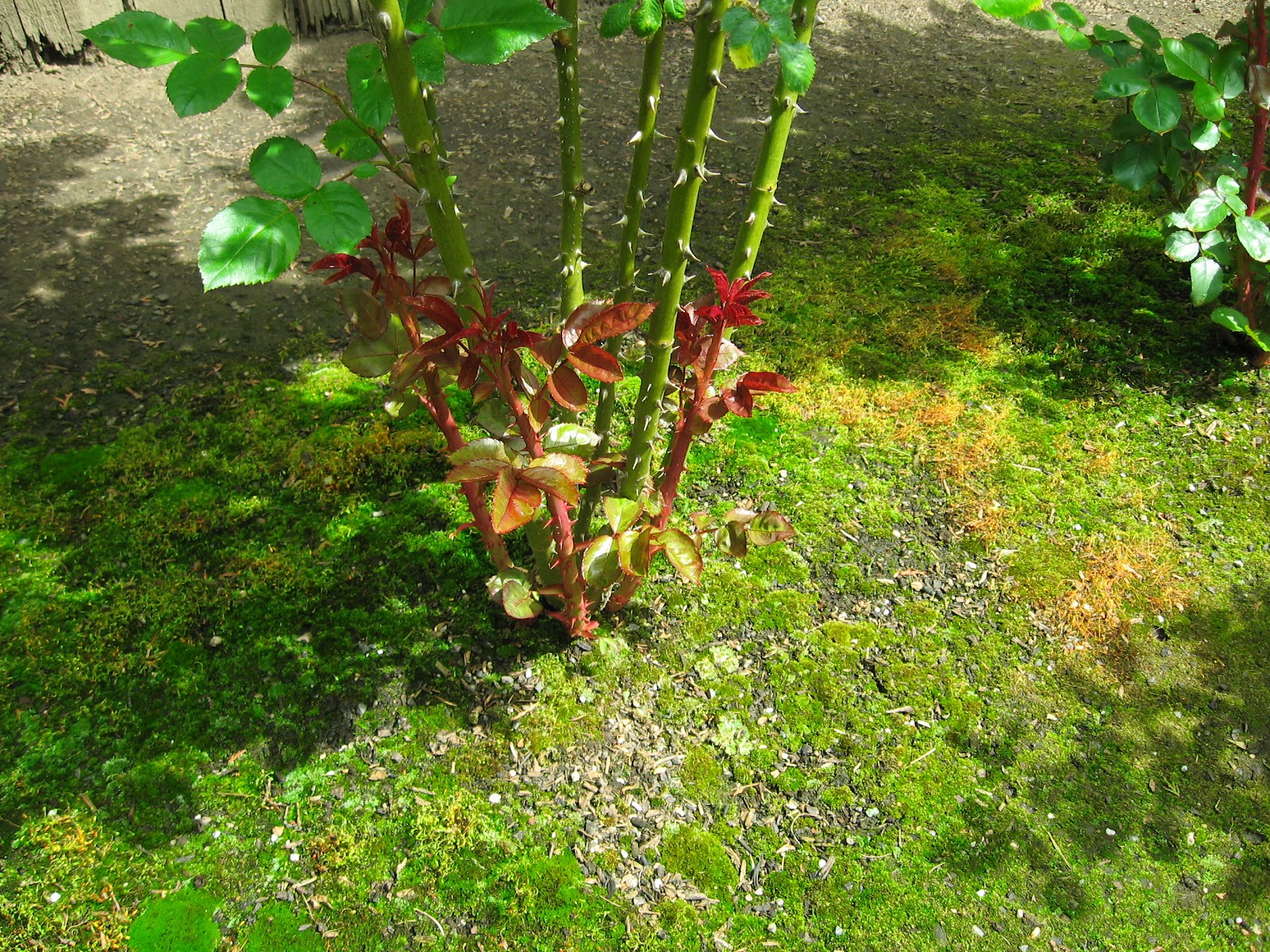
Well, maybe not exactly Moss-Roses, but rather a whole lot of moss growing at the base of my seedling rose bushes. And, I must say, I've been encouraging it to spread -- the combination of rose seedlings and moss is seen in very few rose gardens, to be sure. For you rose purists out there, you can see some REAL Moss-Roses by searching Google Images for "Rosa muscosa". Otherwise, check out the photo below of my rose seedlings growing on a carpet of moss.
May 31, 2012
Singles are nice, too
Rose blooms having between 4 and 8 petals are considered to be "single" (because of their single row of petals). Several of my rose seedlings resulting from open pollination (most likely self pollination) of my 'Queen Elizabeth' roses are, in fact, singles. In general, the bloom size of these seedlings is 3 inches in diameter or more, so they are by no means small. Below are some photos of representative blooms -- the dates beneath each photo are the "birthdays" of the respective seedlings.
| March 4, 2009 |
| March 26, 2010 |
| April 4, 2009 |
| March 15, 2010 |
| March 1, 2009 |
| March 23, 2009 |
| March 20, 2009 |
| March 31, 2009 |
| April 7, 2010 |
OK, so I snuck one in that slightly exceeds the 8 petal limit, but I'm not naming names. Seriously, though, keep the above images in mind when you read my post of December 6, 2011 titled "The BIG rose". There I theorize about the ancestry of the 'Queen Elizabeth' rose. Since 23 percent of my self-pollinated 'Queen Elizabeth' seedlings (9 out of 39) are "singles", I believe that this points very strongly to Rosa roxburghii normalis (not Rosa roxburghii plena) as being one of the grand-parents of the 'Queen Elizabeth' rose.
Update of October 13, 2012: But then again, sometimes I'm not sure what to think. Literature I've recently read indicates that both the "normalis" and the "plena" versions of Rosa roxburghii have spiny calyxes on their rose buds. Not a single one of my 39 self-pollinated 'Queen Elizabeth' seedlings exhibits this characteristic. Referring to my post of December 6, 2011 again: Maybe the grand parent in question was indeed Rosa multibracteata . . . OR . . . maybe 'Baby Chateau' did indeed self pollinate to produce 'Floradora' !
Update of October 18, 2012: Let's take a closer look at the seedling born on March 1, 2009 -- see the fifth photo above. Of all my 'Queen Elizabeth' seedlings, this rose looks the most like some wild species rose from the Orient. How about Rosa bracteata? ( R. multibracteata is more pinkish); see Google Images for some photos of R. bracteata. Below are two photos that I took today of the seedling rose bush. The flower really has an extremely high-pointed bud, which unfurls very easily. What's really confounding is that this rose bush is only 14 inches tall toward the end of its 4th growing season. The plant is complemented beautifully by the carpet of moss.
Update of October 13, 2012: But then again, sometimes I'm not sure what to think. Literature I've recently read indicates that both the "normalis" and the "plena" versions of Rosa roxburghii have spiny calyxes on their rose buds. Not a single one of my 39 self-pollinated 'Queen Elizabeth' seedlings exhibits this characteristic. Referring to my post of December 6, 2011 again: Maybe the grand parent in question was indeed Rosa multibracteata . . . OR . . . maybe 'Baby Chateau' did indeed self pollinate to produce 'Floradora' !
Update of October 18, 2012: Let's take a closer look at the seedling born on March 1, 2009 -- see the fifth photo above. Of all my 'Queen Elizabeth' seedlings, this rose looks the most like some wild species rose from the Orient. How about Rosa bracteata? ( R. multibracteata is more pinkish); see Google Images for some photos of R. bracteata. Below are two photos that I took today of the seedling rose bush. The flower really has an extremely high-pointed bud, which unfurls very easily. What's really confounding is that this rose bush is only 14 inches tall toward the end of its 4th growing season. The plant is complemented beautifully by the carpet of moss.
| Morning of October 18, 2012 |
| Afternoon of October 18, 2012 |
May 22, 2012
A rose by any other name . . .
I went on a field-trip yesterday to the International Rose Test Garden in Portland, where I saw among their thousands of roses some beds of the 'Queen Elizabeth' and 'Voodoo' roses. As mementos, I photographed their respective rose-bed markers:
As you have read (or will read, depending on whether you read this blog from bottom to top or from top to bottom), these two rose varieties play a prominent role as seed parents in my production of new roses. All of my 75+ seedlings, with one exception, are un-named (I identify them by their parent and their "birthday"). The one exception is the rose seedling which I named 'Red Galaxy', and which is now registered with the American Rose Society. For a look at this rose, you may click on the page tab "German seedlings" at the top of this blog (you will find that the rose is appropriately named). To see some REAL red galaxies, search for "red galaxy" on Google Images.
Update of June 17, 2012: I've been waiting to get some presentable photos of my own 'Queen Elizabeth' and 'Voodoo' roses in bloom. The rose bushes shown below have yielded most of the hips and seeds that I have used to produce my new rose seedlings.
As you have read (or will read, depending on whether you read this blog from bottom to top or from top to bottom), these two rose varieties play a prominent role as seed parents in my production of new roses. All of my 75+ seedlings, with one exception, are un-named (I identify them by their parent and their "birthday"). The one exception is the rose seedling which I named 'Red Galaxy', and which is now registered with the American Rose Society. For a look at this rose, you may click on the page tab "German seedlings" at the top of this blog (you will find that the rose is appropriately named). To see some REAL red galaxies, search for "red galaxy" on Google Images.
Update of June 17, 2012: I've been waiting to get some presentable photos of my own 'Queen Elizabeth' and 'Voodoo' roses in bloom. The rose bushes shown below have yielded most of the hips and seeds that I have used to produce my new rose seedlings.
| 'Queen Elizabeth' grandiflora rose Photo taken June 12, 2012 |
| 'Voodoo' hybrid tea rose Photo taken June 17, 2012 |
May 20, 2012
First 'Voodoo' (seedling) bloom of the year
Update of May 25, 2012: The bloom of May 20 is shown 5 days later. I really like the way that the blooms of this rose bush turn a ruby color as they age, rather than bleach out as most roses do. In fact, most of my other 'Voodoo' seedlings undergo the same photochromatic reaction to some degree.
| August 9, 2008 |
| May 20, 2012 |
| May 20, 2012 |
| May 25, 2012 |
May 14, 2012
First open bloom of the year !
The first open bloom of the year is on the same 'Queen Elizabeth' seedling as shown in my posting of April 11th. Interestingly enough, it didn't develop from the bud discovered on the 11th, but from a later bud. Also, this is a full-petaled bloom; I was expecting maybe one of my rose bushes with 5-petaled blooms to be the first of the year. The roses, however, have the final say. Here's the bloom:
Update of May 15, 2012: The following bloom opened just one day later. As expected, it is a 5 petal bloom that doesn't have to struggle to open like a full petaled bloom. This one is also a 'Queen Elizabeth' seedling, and I showed you the plant's "baby picture" in my posting of December 6th of last year that I titled "The BIG rose" (look for the seedling whose birthday is April 4, 2009). Here's a photo of today's bloom:
Both blooms shown above are 3 inch flowers. What they say in the rose literature is quite true -- seedling blooms develop richer coloration over their first few growing seasons.
April 11, 2012
First flower bud of the year !
I've been looking for this -- the first rose flower bud of 2012. This definitely lifts the spirits after a cold and wet winter through early spring. Today, we give special recognition to the 'Queen Elizabeth' seedling whose birthday was March 8, 2009. The first photo below shows the plant's first bloom, which fully opened on July 4, 2009 ( good fireworks). The second photo shows today's first flower bud -- you'll see it in the center of the photo. The third photo shows the proud rose bush today, standing 3½ feet tall just 3 years and 1 month after its birthday.
| July 4, 2009 |
| April 11, 2012 |
![]() |
| April 11, 2012 |
Update of May 19, 2012: In just five weeks, the rose bush is another foot taller and is showing several very pretty blooms. Three new basal canes are developing very nicely, as this rose bush is showing some of the vigor of its seed parent -- 'Queen Elizabeth'. Also, remember that with rose seedlings, there is no mistaken identity over what are "basal breaks" versus what are suckers from a root stock.
![]() |
| May 19, 2012 |
| May 19, 2012 |
Update of May 23, 2012: This would be a good place to sneak in a photo of the author of this blog, Mike. Here I am, out standing in my field, or is it outstanding in my field ? You might recognize the rose bush as the same one pictured above.
| May 23, 2012 |
Subscribe to:
Posts (Atom)