TRANSLATION -- select your language below:

May 31, 2012

Singles are nice, too

Rose blooms having between 4 and 8 petals are considered to be "single" (because of their single row of petals).  Several of my rose seedlings resulting from open pollination (most likely self pollination) of my 'Queen Elizabeth' roses are, in fact, singles.  In general, the bloom size of these seedlings is 3 inches in diameter or more, so they are by no means small.  Below are some photos of representative blooms -- the dates beneath each photo are the "birthdays" of the respective seedlings.

March 4, 2009
March 26, 2010


April 4, 2009
March 15, 2010


March 1, 2009
March 23, 2009


March 20, 2009
March 31, 2009


April 7, 2010

OK, so I snuck one in that slightly exceeds the 8 petal limit, but I'm not naming names.  Seriously, though, keep the above images in mind when you read my post of December 6, 2011 titled "The BIG rose".  There I theorize about the ancestry of the 'Queen Elizabeth' rose.  Since 23 percent of my self-pollinated 'Queen Elizabeth' seedlings (9 out of 39) are "singles", I believe that this points very strongly to Rosa roxburghii normalis (not Rosa roxburghii plena) as being one of the grand-parents of the 'Queen Elizabeth' rose.

Update of October 13, 2012:   But then again, sometimes I'm not sure what to think.  Literature I've recently read indicates that both the "normalis" and the "plena" versions of Rosa roxburghii have spiny calyxes on their rose buds.  Not a single one of my 39 self-pollinated 'Queen Elizabeth' seedlings exhibits this characteristic.  Referring to my post of December 6, 2011 again:  Maybe the grand parent in question was indeed Rosa multibracteata . . . OR . . . maybe 'Baby Chateau' did indeed self pollinate to produce 'Floradora' !

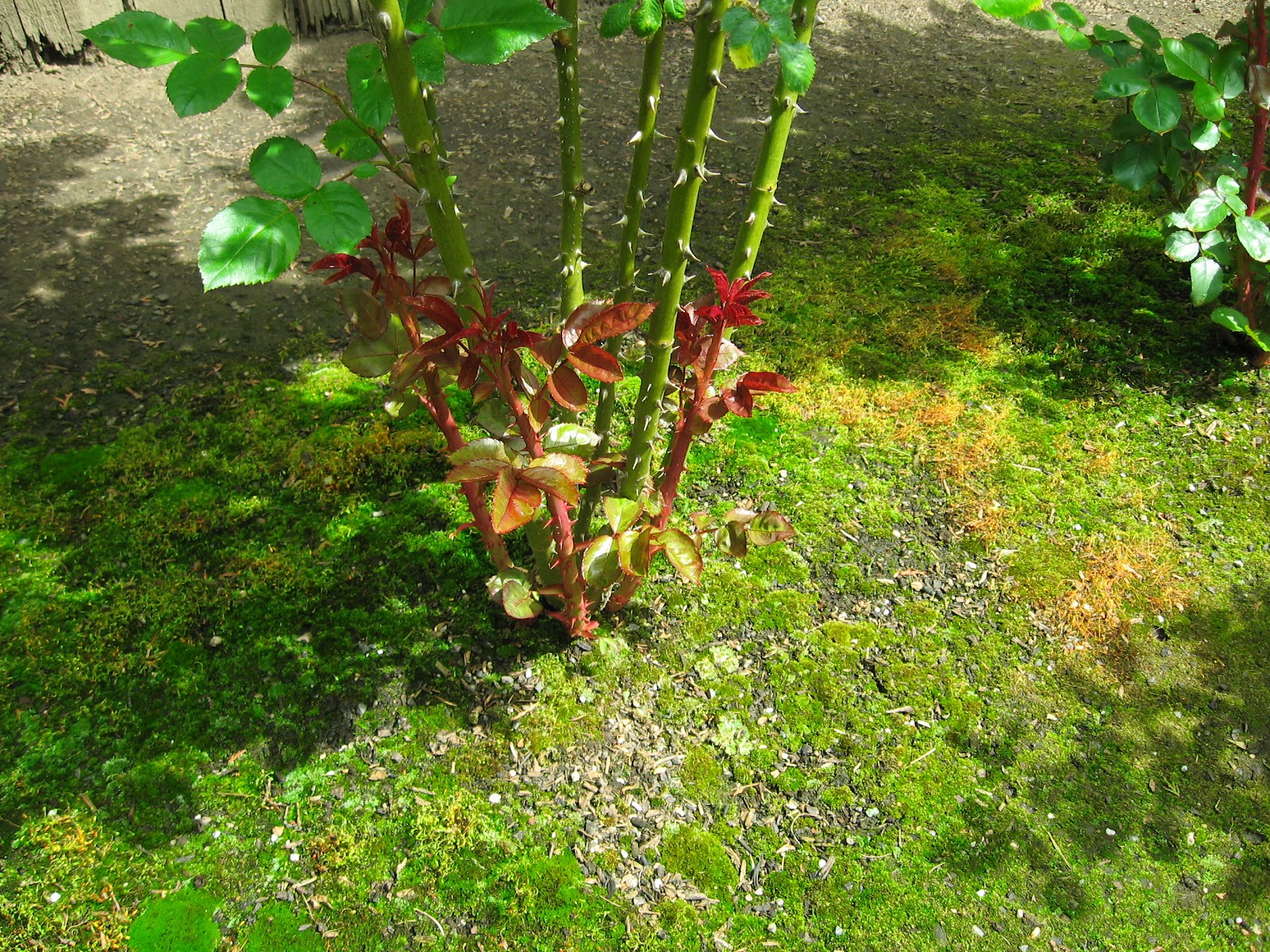
Update of October 18, 2012:  Let's take a closer look at the seedling born on March 1, 2009 -- see the fifth photo above.  Of all my 'Queen Elizabeth' seedlings, this rose looks the most like some wild species rose from the Orient.  How about Rosa bracteata? ( R. multibracteata is more pinkish);  see Google Images for some photos of R. bracteata.  Below are two photos that I took today of the seedling rose bush.  The flower really has an extremely high-pointed bud, which unfurls very easily.  What's really confounding is that this rose bush is only 14 inches tall toward the end of its 4th growing season.  The plant is complemented beautifully by the carpet of moss.


Morning of October 18, 2012
Afternoon of October 18, 2012

May 22, 2012

A rose by any other name . . .

I went on a field-trip yesterday to the International Rose Test Garden in Portland, where I saw among their thousands of roses some beds of the 'Queen Elizabeth' and 'Voodoo' roses.  As mementos, I photographed their respective rose-bed markers:


As you have read (or will read, depending on whether you read this blog from bottom to top or from top to bottom), these two rose varieties play a prominent role as seed parents in my production of new roses.  All of my 75+ seedlings, with one exception, are un-named (I identify them by their parent and their "birthday").  The one exception is the rose seedling which I named 'Red Galaxy', and which is now registered with the American Rose Society.  For a look at this rose, you may click on the page tab "German seedlings" at the top of this blog (you will find that the rose is appropriately named).  To see some REAL red galaxies, search for "red galaxy" on Google Images.

Update of June 17, 2012:  I've been waiting to get some presentable photos of my own 'Queen Elizabeth' and 'Voodoo' roses in bloom.  The rose bushes shown below have yielded most of the hips and seeds that I have used to produce my new rose seedlings.


'Queen Elizabeth' grandiflora rose
Photo taken June 12, 2012
'Voodoo' hybrid tea rose
Photo taken June 17, 2012

May 20, 2012

First 'Voodoo' (seedling) bloom of the year

I have a couple dozen seedlings of 'Voodoo' parentage, but only one can have the first bloom of the year.  This honor goes to a seedling born on June 12, 2008.  As you see in the following photos, the blended colors of today's bloom are much improved over the plant's first bloom that opened on August 9, 2008.  Unlike most of my other seedlings, this rose bush has "semi-double" blooms, as the petal count is 15.  Beginning its 5th growing season, this plant is now 3½ feet tall.  The pictured bloom is 3 inches wide.

Update of May 25, 2012:  The bloom of May 20 is shown 5 days later.  I really like the way that the blooms of this rose bush turn a ruby color as they age, rather than bleach out as most roses do.  In fact, most of my other 'Voodoo' seedlings undergo the same photochromatic reaction to some degree.

August 9, 2008
May 20, 2012


May 20, 2012
May 25, 2012

May 14, 2012

First open bloom of the year !

The first open bloom of the year is on the same 'Queen Elizabeth' seedling as shown in my posting of April 11th.  Interestingly enough, it didn't develop from the bud discovered on the 11th, but from a later bud.  Also, this is a full-petaled bloom; I was expecting maybe one of my rose bushes with 5-petaled blooms to be the first of the year.  The roses, however, have the final say.  Here's the bloom:


Update of May 15, 2012:   The following bloom opened just one day later.  As expected, it is a 5 petal bloom that doesn't have to struggle to open like a full petaled bloom.  This one is also a 'Queen Elizabeth' seedling, and I showed you the plant's "baby picture" in my posting of December 6th of last year that I titled "The BIG rose" (look for the seedling whose birthday is April 4, 2009).  Here's a photo of today's bloom:


Both blooms shown above are 3 inch flowers.  What they say in the rose literature is quite true -- seedling blooms develop richer coloration over their first few growing seasons.

April 11, 2012

First flower bud of the year !

I've been looking for this -- the first rose flower bud of 2012.  This definitely lifts the spirits after a cold and wet winter through early spring.  Today, we give special recognition to the 'Queen Elizabeth' seedling whose birthday was March 8, 2009.  The first photo below shows the plant's first bloom, which fully opened on July 4, 2009 ( good fireworks).  The second photo shows today's first flower bud -- you'll see it in the center of the photo.  The third photo shows the proud rose bush today, standing 3½ feet tall just 3 years and 1 month after its birthday.

July 4, 2009
April 11, 2012
April 11, 2012

Update of May 19, 2012:   In just five weeks, the rose bush is another foot taller and is showing several very pretty blooms.  Three new basal canes are developing very nicely, as this rose bush is showing some of the vigor of its seed parent -- 'Queen Elizabeth'.   Also, remember that with rose seedlings, there is no mistaken identity over what are "basal breaks" versus what are suckers from a root stock.


May 19, 2012
May 19, 2012


Update of May 23, 2012:  This would be a good place to sneak in a photo of the author of this blog, Mike.  Here I am, out  standing in my field, or is it outstanding in my field ?  You might recognize the rose bush as the same one pictured above.

May 23, 2012

March 22, 2012

This is Spring ?

Spring is off to a cold start here in Salem as an unusual storm brought snow to the valley.  I'm sure that the roses will shrug it off and thrive for another year.  This is what the big rose bed looked like on the mornings of the third and fourth days of spring.  I measured 3 inches of snow on the backyard picnic table.

March 21, 2012
March 22, 2012
Update of March 23, 2012:   Weather conditions can change pretty fast around here.  Today actually turned into a very pleasant day, with the sun melting off most of the snow except for what remains in the shade.  Here's a photo that I took this afternoon:

March 23, 2012

December 22, 2011

PAGES and TRANSLATION

Well, I might be on break from tending the roses, but I made good use of this downtime by adding a new feature to this blog.  Introducing:  PAGES !  These are where I'll show you a representative sample of my rose seedlings and keep you abreast of their growth.  The pages are accessible via tabs, which you will see above the first post in this blog (underneath GREETINGS).  From a page, you can skip to any other page, and you can always come back to HOME.     And for my rose growing friends around the world, I have added a TRANSLATION tab, seen at the top of this blog.

December 17, 2011

A "crown" befitting a Queen

Just one more thing before I go on Winter break.  I wanted to show you something from the garden, where the roses are enjoying their much deserved rest.  One of my 'Queen Elizabeth' seedlings has a remarkably symmetrical crown.  This is something that you are not very likely to see on other roses, especially the budded kind.  This bush is just 1 month shy of being 4 years old.

Birthday: 1/23/2008    Photo taken: 12/17/2011
First bloom: 6/26/2008

Update of June 2, 2012:   The "birthday" of January 23, 2008 is significant, because this seedling is the first of all of my seedlings to be born here in Salem.  The seedling is now 4 years and 4 months old; it is a substantial rose bush standing nearly 6 feet tall.  Below are a couple of photos that I took today.  The first photo revisits the seedling's crown which has been cleared of a few non-productive canes and has added a few new ones.  I hope that the second photo does justice to this really impressive rose bush.


Update of August 14, 2012:   I had to back away today to fit most of the rose bush into the next photo.  I measured its height to be exactly 7 feet, and it's a little bit older now, at 4 years and 7 months.


December 7, 2011

Winter break

 I'm happy to have shared with you my knowledge of growing roses from seed.  It's time to take a Winter break.  Please consider revisiting this blog occasionally -- I'm planning to have some new and exciting photos of my roses posted next growing season.  For now, the roses are in the backyard taking a break, too,  as can be seen in the following photo:


I'm going to let the moss take over.  That should make for an unusual rose garden floor.  All of the roses in the big bed (except for two 'Queen Elizabeth' roses) were grown from seed.

I just knew this was a seedy blog

In my previous post,  I explained what to do to obtain ripe hips that will contain viable seeds.  Within a day or so after harvesting the hips, I open them, extract the seeds, and then plant the seeds without delay.  (Remember: you may need to pre-chill your hips/seeds if you live in a warmer climate.)   I like to use Miracle-Gro Potting Mix, with which I fill 3 inch pots, and then add water to moisten the soil.  I plant 4-5 seeds per pot at a depth of around a quarter of an inch.   I put as many of the pots that will fit onto those black plastic tray things that come with transparent domes and then place them on a table close to a window at regular room temperature.  Then it's time to wait !    The majority of my seeds germinate at around 3 to 5 months, with a few as early as 1½ months.  Around the month of March the following Spring, I move the covered tray outdoors and wait some more.  After 6 months or so, I pretty much shut it down, if you know what I mean.   If you have lived a righteous life, your seeds will begin to sprout like this:


Wow, that looks like a giant pot !   Actually, it's one of those 3 inch pots into which I planted 4 seeds around the corners (but not too close to the sides) and maybe a fifth seed in the center.  The pot is sitting on a window sill so that the little rose seedling will get better light.  The photo was taken on the seedling's "birthday" -- January 13, 2011.  After a couple of weeks or so, I VERY GENTLY extricate the seedling and move it to its own larger (4 inch) pot.

I think I get around a 20 percent germination rate.  Unfortunately, you'll find that not all seedlings are created equal and that some will die within a few weeks.  That's just the way it is.  The majority seem to survive, and those are the ones that I shuttle outdoors in their 4 inch pots to "harden off" as weather permits.  I always place the outdoor pots behind protective fencing, so that squirrels will not be digging around.  In fact, even after I plant the seedling out in the garden, I'll use protective fencing for all of the first growing season and a good part of the second.  Here's a photo that demonstrates what I'm talking about (click on the photo to enlarge it):


See, no squirrels !  The above plant is a seedling of the hybrid tea rose named 'Voodoo'.  The seedling was born on April 29, 2011 and the photo was taken today, December 7, 2011.  Here's what the seedling's first bloom looked like (the protective screen was briefly removed);  the photo was taken on July 8, 2011:


So there you have it -- the "Secrets of the Temple".   As you probably already know, there is a wealth of information about growing roses from seed out there on the Internet.  Choose whatever methods that you can get comfortable with, and GOOD LUCK  !

December 6, 2011

The hipster

To be a hipster, you're going to have to be a little backward.  Let me explain.  Normally, you should be deadheading spent blooms on your roses to encourage your plants to keep growing and blooming throughout the Summer and into Fall.  If you want hips that contain viable seeds, however, you'll need to let hips develop and remain on the bush until they get nice and mature.  Here is my backward scheme --
Here in Salem, I leave blooms alone until the end of July, maybe gently plucking off unsightly petals (but no more than that).  Remember, I let nature take its course, and depend on open ( or self) pollination.  This allows about 1½ months of blooms to develop hips (middle of June through the end of July).  Beginning in August, I deadhead all the NEW blooms after they are spent, leaving the earlier hips alone (they should resemble hips by then).  I harvest the hips at the end of November, or before the first hard freeze (under 25 degrees).  This guarantees that the hips have aged for at least 4 months, namely August through November.  Hips on various rose types do not necessarily turn a rich orange or reddish color when they mature.  Hips on my 'Queen Elizabeth' and 'Voodoo' roses turn a very slight shade of orange.  So, the above method avoids any confusion concerning older and newer hips because there are NO newer hips.  As a matter of fact, the strong 'Queen Elizabeth' rose will continue blooming very nicely even while still retaining its early hips.  You didn't realize you were a hipster, did you?

I should add that here in the central Willamette Valley, the month of November does just fine for getting the seeds "stratified" as the hips are ripening on the bush.  If you live in a warmer region of the world, you will probably need to refrigerate your hips/seeds for a month or so.

The BIG rose

A couple of posts back (see "A Seattle garden"), I highlighted the great 'Queen Elizabeth' rose, and its willingness to grow rather big.  That was just what I needed to produce some vigorous rose seedlings to populate my new garden in Salem, Oregon.  I wasn't disappointed.   To circumvent the dilution of the gene pool, I just let my purchased 'Queen Elizabeth' roses open pollinate, which most likely meant self pollinate.  I also had another motive for this.  With self pollination, I would basically re-shuffle the gene pool and maybe get a better idea wherefrom 'Queen Elizabeth' came.  Rose "bibles" say that its parents were 'Charlotte Armstrong' (seed) and 'Floradora' (pollen).  In turn, the parents of  'Charlotte Armstrong'   were 'Soeur Therese' (seed) and 'Crimson Glory' (pollen), whereas the parents of 'Floradora' were 'Baby Chateau' (seed) and Rosa roxburghii (pollen).  Pictures of all of these roses can be seen on Google Images.  There's not a BIG rose in that bunch, except for R. roxburghii.  But what I wanted to know was this: was it R. roxburghii plena (the rose with LOTS of petals), or was it R. roxburghii normalis (described as having 4 to 8 petals); again, both can be seen on Google Images.  Rose literature is unclear about which roxburghii Mathias Tantau, the German hybridizer, used to pollinate 'Baby Chateau' when he bred 'Floradora'.

My guess is that it was R. roxburghii normalis.  My seedlings from 'Queen Elizabeth' are showing quite a few "singles", namely rose plants having blooms of 5 petals or so.  Below, I'll show you some of my seedlings at the time they opened their first bloom.  This coming Summer, I'll take some photos of the grown-up plants, so stay tuned.  Click on the photos to enlarge them.  Also, note that it usually doesn't take very long for a rose seedling to show you its first bloom.                                                                 

Update of May 28, 2012:   The grown-up rose bushes are starting to bloom -- to see them, click on the "Queen Elizabeth seedlings" tab at the top of this blog.

Seedling born 3/04/2009, first bloom 5/31/2009
Seedling born 4/04/2009, first bloom 6/10/2009


Seedling born 3/23/2009, first bloom 7/05/2009
                           
Switching gears, here now is an example of a full blossomed seedling from 'Queen Elizabeth': 

Seedling born 3/26/2009, first bloom 6/10/2009


And here is the same rose just two years later (June 26, 2011), standing as tall as I am -- 5½ feet !
Note the 'Queen Elizabeth' bloom in the foreground.


This paragraph is for SERIOUS ROSE DETECTIVES:  for many years, it was thought that Mathias Tantau had used Rosa multibracteata as the pollen parent when he hybridized 'Floradora'.  Pictures of Rosa multibracteata as well as Rosa roxburghii normalis may be seen on Google Images.  Things get more interesting because Herb Swim, a great American rose hybridizer, came to the conclusion that 'Floradora' was the result of a SELF pollination of 'Baby Chateau' (refer to page 76 of Swim's book:  "-- ROSES --  from Dreams to Reality", published in 1988).  One might say that the ancestry of the 'Queen Elizabeth' rose remains SHROUDED IN MYSTERY !

Onward to Oregon

In March of 2007 I moved again, this time to Salem, Oregon, thus completing the West-coast trifecta of California, Washington, and Oregon.  I left all the Seattle roses in place, hoping the next residents would enjoy them.  In Salem, I began again to construct a rose garden, but this time growing my own roses from seed.  I discovered that one rose bush already existed on the property.  Thankfully, it had a tag identifying itself as the hybrid tea rose named 'Voodoo'.   Great, I would just let it grow some hips and then have its seeds ready for planting in November, 2007.  The next course of business in March was to head over to the local Fred Meyer's and purchase some bagged bare root 'Queen Elizabeth' roses.  Promptly planted, they also yielded hips and seeds for late 2007.   In the Summer of 2008, I was the recipient of some hips (from 3 unknown rose varieties) sourced from Germany.  I planted the seeds from those hips outdoors, in a patch of ground, that Summer.  Some of these German seeds germinated in the Fall of 2008, and some the following Spring.  { IMPORTANT NOTE:  Normally I harvest hips in late November and plant their seeds in small pots for germinating indoors.  If you plant your seeds outdoors, you MUST protect your seedlings from slugs and cutworms and such.  I do it by potting up the seedlings  just a couple of days after they surface and then placing the pots in a protected location.  You will find that outdoor-grown seedlings are tougher than indoor-grown seedlings, and can be handled early on; however, be very careful when you pot them up. }

To summarize:  all of my rose seedlings have been grown from 'Voodoo' seeds, 'Queen Elizabeth' seeds, and seeds of unknown German roses.

So, here's how the garden looked in October of 2009.  Most of the roses were grown from seed.  Click on the photos to enlarge them.


And, after growing and adding new seedlings to the garden from 2008 through 2011, here's how the garden looked in late June of 2011.  All except 2 roses were grown from seed.  Can you identify one of the 'Queen Elizabeth' roses?


As a bonus, here's a video of the grounds that I took in July of 2011.  It's also viewable on YouTube under the title:  Rose garden panorama(2011).

  
Note that at the bottom of this blog you will see a live link to "My YouTube Videos".  Click on it and you will be directed to, what else, a stack of all of my rose seedling related YouTube videos.

A Seattle garden

In late 1996 I bought a house in Seattle and proceeded to carve out rose gardens in both front and back yards.  I grew store-bought roses for several years, the result being what you see in the following photos:
 
Front yard
Back yard
Of particular note is the tall pink-blossomed rose growing to a height exceeding that of the patio cover.  The plant was the 'Queen Elizabeth' rose.  Since I am an advocate of light pruning, the rose plant was very obliging and grew to over 10 feet tall !  I was glad to get on a step ladder to deadhead this plant -- anything to keep it happy.  It made such an impression on me that I chose this rose variety again as the mainstay of my rose growing when I switched to growing roses from seed.  This was after I moved from Seattle to Salem, Oregon in 2007.

Predisposition (Ontario, CA)

Although the previous post (below) describes my latter-day "hands on" introduction to roses, there's SOMETHING about my days as a young lad that may have predisposed me to this "way of life".  Growing up in Ontario, California in the 1950s, I was surrounded by beauty, including ROSE beauty as seen in the following photos --


Climbing roses beautifying handsome block walls in both front and back yards !   THAT'S IT !  Everything you see above was built and planted by my Dad, with some help from his sons (and my Mom, who liked Easter lilies as well as roses).